Garden Maintenance Finchley: Recycling and Sustainable Gardening Practices
As a dedicated Garden Maintenance Finchley team we prioritise an eco-friendly waste disposal area within every project. Our Finchley garden maintenance services are designed to reduce landfill, rehome usable materials and treat green waste as a valuable resource. In practice this means designing a sustainable rubbish gardening area on-site where cuttings, soil and timber are sorted for reuse, composting or transfer to appropriate facilities rather than being sent to general waste.Creating an eco-driven rubbish gardening area is about more than a tidy site: it reduces emissions, saves money and supports local circular-economy initiatives. The borough's approach to waste separation (for example, separate collections for dry recycling, garden waste and residual rubbish, and food waste where provided) informs how we set up segregation points at every client garden. We work with residents to label bins clearly, use colour-coded sacks and ensure the right materials reach the right destination to support council recycling streams.
 Our operational target is ambitious and measurable: we aim for a 60% recycling rate across all green and recyclable materials collected from jobs within three years. That recycling percentage target covers on-site composting, segregation for municipal recycling, and re-use or donation where possible. Typical activities that feed that target include:
- Separating woody cuttings for chipping and mulch
- Collecting soil and planter materials for screening and reuse
- Diverting pots, tools and functional materials to reuse partners
We coordinate collections with local transfer stations and processing hubs to keep material moving through low-impact channels. For clients in Finchley and neighbouring areas we routinely use North London transfer facilities such as the Edmonton EcoPark and nearby transfer stations operated by borough partners. These facilities enable efficient sorting, energy recovery and composting — all part of a low-waste strategy that complements our garden maintenance in Finchley.
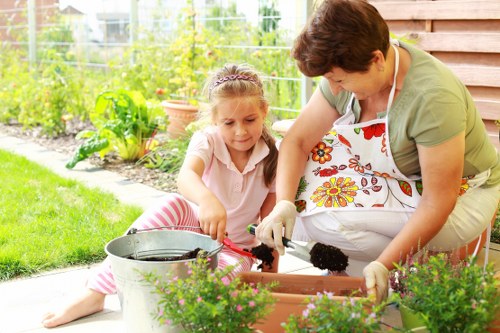 On-site composting is central to a sustainable rubbish gardening area: where space allows we set up dedicated compost bays or tumblers to transform green waste into soil conditioner. We also support community composting schemes and local allotments by donating finished compost. Finchley garden maintenance projects routinely benefit from returned mulch and compost, reducing the need for new peat-based products and closing nutrient loops within the neighbourhood.
Partnerships with charities and social enterprises amplify the impact of our waste avoidance work. We collaborate with local reuse charities, community groups and organisations such as Groundwork London and neighbourhood green initiatives to rehome usable materials. Typical partnership activities include:
- Donating pots, planters and working tools to community gardens
- Supporting social enterprise projects that refurbish and resell garden equipment
- Supplying compost and mulch to local allotments and food-growing groups
 Our fleet is built around low-emission principles: we use electric and hybrid vans where practicable, alongside Euro 6 diesel vehicles for longer runs. All vans are fitted with telematics and route-optimisation software to reduce mileage and idle time, cutting fuel consumption and carbon emissions for every Finchley gardening services run. Vehicle choice and load planning are treated as part of each job's environmental assessment to ensure an efficient, low-carbon approach to waste transport.
Measurement and transparency are key. We produce regular internal reports that map material flows from client's garden to the disposal or reuse point, tracking how much is composted, recycled or rehomed. This monitoring helps us refine the sustainable rubbish gardening area setup on repeat visits, and it supports borough-level objectives by aligning with local recycling policies and collection timetables. Garden maintenance in Finchley therefore contributes to a larger municipal effort to increase reuse and recycling.
 In summary, our Finchley garden care programmes blend practical on-site solutions with strategic partnerships to deliver verifiable environmental benefits. From setting up segregation points and community compost bays to partnering with reuse charities and using low-carbon vans, our approach to garden maintenance Finchley-wide seeks to make every garden job part of a greener local economy. Whether you need sustainable garden clearance, regular maintenance that prioritises recycling, or a one-off tidy that keeps materials in circulation, our methods emphasise reuse, minimised transport emissions and measurable recycling outcomes — all tailored to the way local boroughs handle waste separation and recovery.
Key sustainability actions
Best practices we follow
- Segregation at source — clear, labelled areas for green waste, recyclable materials and reusable items.
- On-site reuse — screening soils and returning compost and mulch to customers or community schemes.
- Partner redistribution — donating usable goods to local charities and social enterprises.
- Low-carbon transport — electric/hybrid vans plus route optimisation to reduce emissions.
By combining practical site systems, meaningful recycling percentage targets and local partnerships, our garden maintenance services in Finchley deliver a realistic and accountable model for sustainable urban gardening. These steps support the circular economy, respect borough waste separation frameworks and make green spaces healthier and more resilient for the whole community.